When we cook we are naturally aware of the ratio between ingredients… We know that a little snatch of white wine in the hollandaise sauce is good, but half a liter would ruin it.
The same rule applies, when we practice and prepare for a concert or audition. However, most of us forget or neglect this fact.
We tend to concentrate our energy around the things we find difficult. Some might even have been told to do so. Of course, we do have to spend time around, whatever is causing us problems… But often we spend a ridiculous amount of time on very few bars and neglect everything else in our playing.
A one-note concerto?
For trumpet players, like myself, a good example is the Haydn trumpet concerto. In the middle section, this concerto has a passage that goes to a fairly high note. Say the words “high E-flat” to a trumpet player, and the first thing that will pop into his or her mind is the Haydn Trumpet Concerto!
This means that proportionally trumpet players spend an enormous amount of time practicing this exact bar that leads up to the high E-flat. With so much focus on one specific note, it´s hard not to worry about it also when not playing. Furthermore, if you play the whole concerto with a lot of splits and generally out of tune, but gets the high E-flat, some trumpet players (quite a few, I believe) will categorize it as a successful performance. This obviously is a problem, since to the audience, this note is something like 0,0001 % of the entire concerto. It doesn´t mean more, just because it´s difficult.
Another problem with this way of thinking is that if we only focus on the things we find hard, we don’t anymore build ourselves up while practicing. We easily end up practicing a lot without any remarkable results. We might even get worse.
Don´t let small problems create big impacts!
During my trial year in “Sinfonietta Riga”, we had to play a quite hard and demanding modern piece. I was preparing this piece every day for more than a month. After 2-3 weeks of preparing, I found myself struggling and playing worse and worse.
At this time I hadn’t yet realized that I was focusing all my energy around exactly 4 bars that I found difficult. I didn´t see or acknowledge, that I actually played most of the things in the piece quite well because my inner success criteria were based only on those 4 bars. Spending so much time practicing those 4 bars, made me exhausted both physically and mentally. I actually began doubting myself as a trumpet player and as a musician… Do you think that was helpful??
Luckily, I realized this 2 weeks before the concert and I created for myself a concept that I call “proportional focus”. This helped me to get a better and more balanced focus in the last weeks leading up to the concert which after all turned out to be a good experience.
Setting your proportional focus
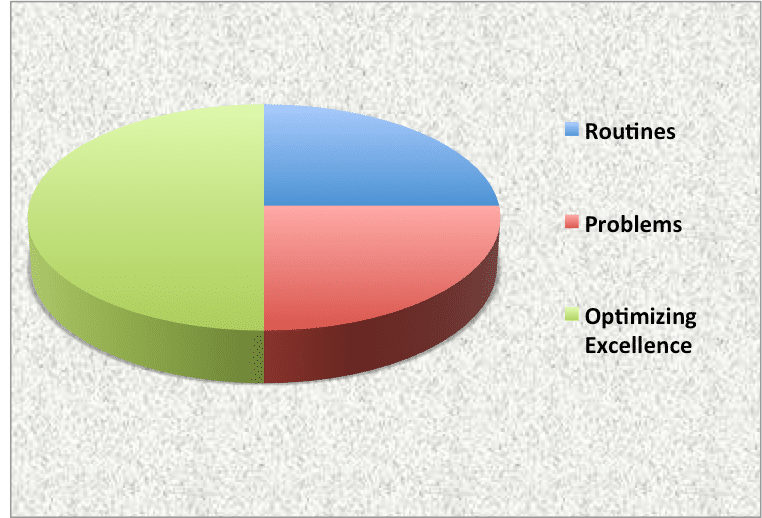
Proportional focus outlines how much time you should spend on:
- Routines and habits (such as warm-up and basics like scales, arpeggios, lyrical studies etc.)
- Optimizing excellence (material such as solo pieces, orchestral repertoire, and etudes that you already can play, but where you can work on deeper levels of excellence. This could be working on better sound, phrasing, different articulations, rhythm etc.
- Addressing my concrete problems (what specific parameters are causing trouble? This could be a group of fast notes, high notes or maybe a long phrase that is hard to play all the way to the end etc.)
Routines
I personally like to spend around 25 % of my time on known routines, where I with slight variations repeat a set of exercises to make my performance stable. You can compare this to watering your garden daily. By routine, however, I don’t mean a set of exercises that you repeat unconsciously but a routine that you have practiced and mastered over a long period of time and therefore can play on your absolute highest level. A level that should set the standard for the rest of your daily practice.
Optimizing excellence
Now, if we only play something that we already played very well and with ease, we won’t develop much further. Therefore we also need to work on optimizing excellence. I like to do this approximately 50 % of my practice time, taking repertoire and etudes that are within my capability but that can be improved in details. Even things that might seem simple at first, can be improved dramatically if we really pay attention to details in this process. This way of perfecting your playing is an excellent way to programme and code the neuronal network in your brain to make you better and more secure in doing whatever you are doing.
Addressing the concrete problem
Finally, I strive to spend 25% of my time addressing my specific problems directly. In this process, it’s unavoidable that we push and strain a little. Even when we try to increase the difficulty slowly, we will at some point have to push a little in order to extend the borders. This is completely okay, as long as we don’t do it too long at a time and as long as we immediately try to establish good habits in the new material.
It can vary how much time each of us needs to spend on our routines, problems etc. and you will have to find your own proportional focus. You can do it yourself or maybe with some help from a teacher, friend, colleague or coach that can help you see things from an outside perspective.
When you have found your proportional focus, set a timer and follow it. Don´t allow yourself to be tempted to suddenly spend 90 % of your time on one little specific problem. Over time, you will overcome your problem – even with 10 or 20 minutes a day.
Leave a Reply